InvestmentAchievementsTestimonialsAuthorContact
🇬🇧 EN 🇸🇦 AR 🇩🇪 DE 🇫🇷 FR 🇪🇸 ES

The systems lab / 01—12

Simulations

A small change. A different world.

Explore how startups, cities, friendships and families evolve. Change the assumptions, run an experiment and follow the consequences.

Runs in your browser. No account or installation needed.

Why this lab exists

A place to question complex systems

Hesham built this lab to make complex systems easier to question. Instead of accepting a single answer, you can test a small change and see how a synthetic world responds.

How to learn here

Ask, change and compare

Start with a question or a saved preset. Pause a run, change an agent or a rule, then compare the data with a matched baseline. Named browser-local saves let you return to an experiment; every project explains its assumptions and limits.

Choose a project

Explore the simulation projects

Each project is a simplified model for learning, not a prediction.

Guided and advanced workspaces in English, Arabic, German, French and Spanish.

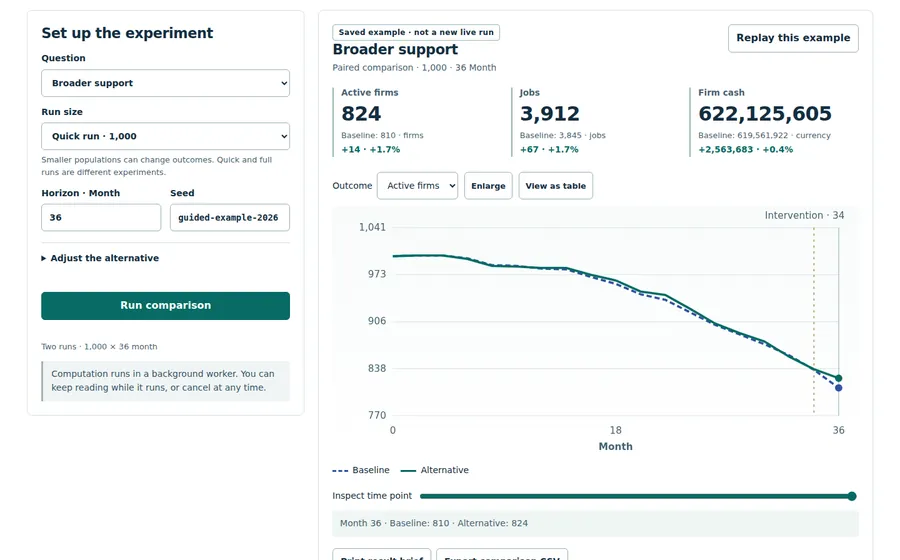
Startups & capital

Venture Ecosystem Lab

Build a synthetic startup ecosystem and explore how financing, competition and economic shocks affect companies and investors.

Quick: 1,000 companies · Full: 10,000 companies

Explore simulation — Venture Ecosystem Lab
Cities & housing

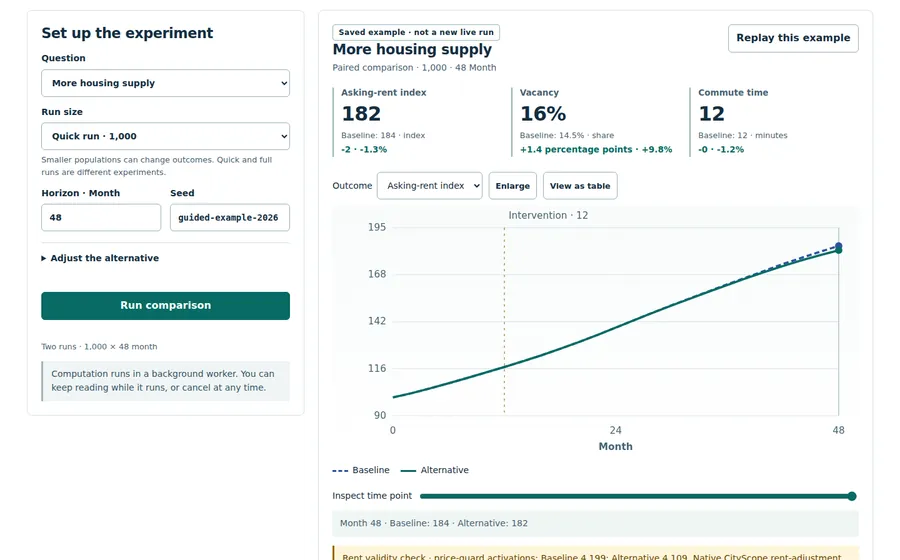
CityScope

Explore the connections between housing, jobs, transport and household decisions across a synthetic city.

Quick: 1,000 households · Full: 10,000 households

Explore simulation — CityScope

Friendship & networks

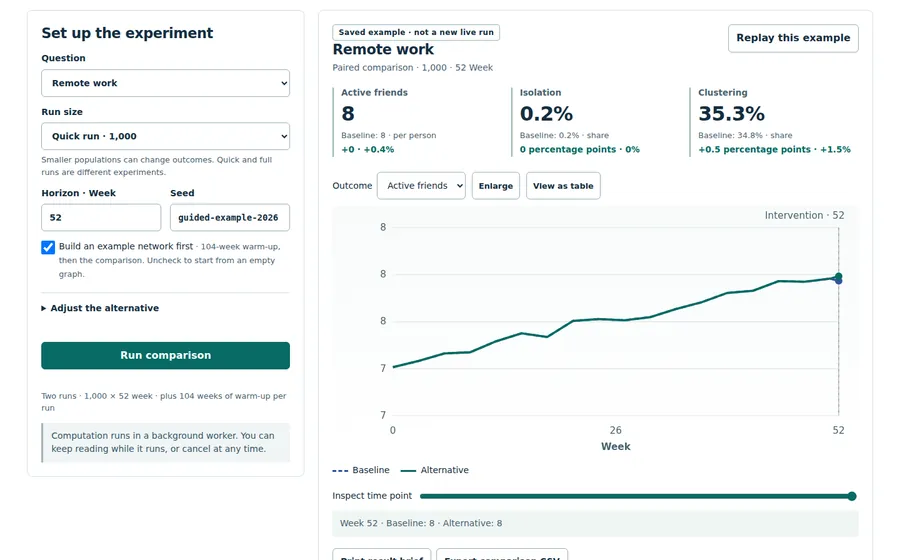
Friendship Lab

See how encounters, attention and available time shape friendships and social networks over time.

Quick: 1,000 people · Full: 10,000 people

Explore simulation — Friendship Lab

Families & population

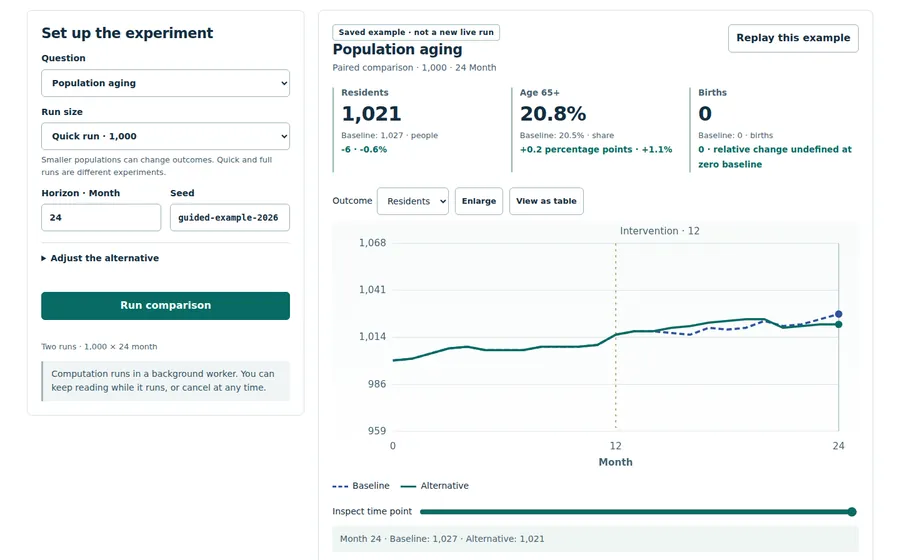
Kinship Lab

Explore family formation, births, ageing and kinship as a synthetic population changes across generations.

Quick: 1,000 people · Full: 10,000 people

Explore simulation — Kinship Lab

Learning labs

Adoption and churn

A finite population adopts through innovation and well-mixed imitation.

Four question-led scenarios · Editable individuals · Saved results

Open the lab — Adoption and churn

Learning labs

A four-stage supply chain

Orders and physical goods move through a retailer, wholesaler, distributor, and factory.

Four question-led scenarios · Editable individuals · Saved results

Open the lab — A four-stage supply chain

Learning labs

Repeated cooperation

Random pairs play a repeated Prisoner’s Dilemma with pair-specific memory.

Four question-led scenarios · Editable individuals · Saved results

Open the lab — Repeated cooperation

Learning labs

Auction rules and budgets

One indivisible item is offered to bidders with independently redrawn private values.

Four question-led scenarios · Editable individuals · Saved results

Open the lab — Auction rules and budgets

Learning labs

Information cascades

Misinformation and corrections spread once per newly active node over fixed edges.

Four question-led scenarios · Editable individuals · Saved results

Open the lab — Information cascades

Learning labs

Synthetic wealth distribution

Synthetic households save income, receive returns and transfers, experience losses, and exchange wealth.

Four question-led scenarios · Editable individuals · Saved results

Open the lab — Synthetic wealth distribution

Learning labs

Traffic on a ring

Cars follow the Nagel–Schreckenberg cellular automaton on a one-lane circular road.

Four question-led scenarios · Editable individuals · Saved results

Open the lab — Traffic on a ring

How to read the results

These are exploratory models using synthetic populations. Their results illustrate assumptions and scenarios; they are not calibrated forecasts.